Featured in Mongabay A sea cucumber venture in Zanzibar seeks to balance business and conservation All press →
The Model · CORE Zone Partnerships
Zanzibar · Western Indian Ocean

A self-financing ocean enterprise, from first harvest.

A CORE Zone is a partnership between Asili Company and a village cooperative, in an area of sea the community has closed through its Shehia Fishers Committee. The enterprise that depends on a healthy sea pays for the protection that keeps it healthy.

Site Structure

One area of ocean, closed to fishing.
Ranched by the community.

A CORE Zone is the whole community-managed ranching area. It is closed to fishing of every species, and the same rules, ownership and governance apply across all of it.

The Closed Area

Closed to fishing
of every species

No fishing, gleaning or taking of any marine life inside the boundary. Seaweed farmers keep farming inside the area. Sandfish are ranched across the seagrass, and the wild sea cucumbers, fish and invertebrates inside are protected too.

Sea cucumbers feed on the waste of a healthy, full ecosystem. The ecological recovery and the commercial production happen in the same place. They are the same thing.

Patrol & Stock Retention

Watched by the community,
netted where needed

The cooperative and the SFC patrol the area from watchtowers and floating security rafts. Breaking hifadhi rules is against fisheries law, and repeat offenders are reported to the SFC.

Where site conditions require it, part or all of the area is fenced with floated netting to keep the ranched stock in. The netting holds the stock. It does not create a separate zone.

How the CORE Zone Relationship Begins

The community closes the area.
Everything else follows from that single act.

A CORE Zone begins when a community, through its Shehia Fishers Committee, Beach Management Unit, LMMA association or equivalent body, decides at open town halls to close an area of its sea. From then on, the partnership brings:

Wages Before Harvest

Paid work for the people who patrol and run the ranch, offered first to the fishers who used the area. Communities earn before any harvest.

Patrol Infrastructure

Watchtowers, floating security rafts and patrol equipment, owned by the cooperative.

Juvenile Supply

Hatchery-raised H. scabra juveniles to stock the seagrass, with no up-front cost to the community.

Technical Support + Markets

Training and technical extension, plus processing, quality control, traceability and the route to market.

The model applies wherever sandfish are native across the tropical Indo-Pacific: Shehia Fishers Committees in Zanzibar, Beach Management Units on mainland Tanzania, LMMA associations in Madagascar, and equivalent community governance bodies across the region.

Operations

Six stages. One continuous cycle.

01

The Community Decides and Closes the Area

The SFC and the Sheha hold open town halls that explain the whole model: the closure, the shifts, the wages and how returns are shared. Men and women sign up on separate lists. SFC members then lay the boundary buoys, and the area closes to fishing of every species.

02

Infrastructure, Wages & Juvenile Supply

The cooperative receives its patrol infrastructure and equipment, the workforce starts on wages, and the first hatchery-raised juveniles are stocked. The community is equipped and earning before the first animal reaches harvest size.

03

Community-Managed Ocean Ranching

Sandfish grow at their natural pace on the seagrass, under community governance. Cooperative members patrol, monitor the stock and the seagrass, maintain any netting and check growth, on shift patterns the community sets itself.

04

Other Regenerative Mariculture

Seaweed farming continues inside the area. Where it raises sustainable incomes without harming the ecosystem, the community can add other regenerative mariculture by agreement.

05

Harvest, Processing & Traceability

Mature sandfish are harvested under agreed protocols, processed by Asili into export-grade bêche-de-mer, and logged so each batch can be traced from hatchery to export.

06

Shared Returns, Monitoring & Adaptive Management

Returns are shared as set in the partnership agreement: half to Asili, a quarter to the workforce, a quarter to the village. Growth trials and community monitoring guide stocking and management for the next cycle.

Governance

A genuine partnership. Legally documented at inception.

Each CORE Zone has clear responsibilities, rights and returns on both sides, and the area stays under community governance at all times.

The community provides

  • The decision to close the area, made through the SFC and the Sheha
  • The rules of the area and their enforcement
  • The workforce: patrol, monitoring, ranching and harvest
  • Local ecological knowledge and site decisions
  • Its own working arrangements, such as shift timing and roster days
  • Transparent sharing of the community's returns

Asili Company provides

  • Hatchery-raised juveniles and nursery support
  • Patrol infrastructure and equipment, including watchtowers and floating security rafts
  • Technical extension, training and scientific support
  • Processing, quality control and export
  • Traceability and market access
  • Wages before the first harvest, channelled through public co-investment

There are two separate documents. The closure of the area is the community's own decision and record. The partnership and profit-sharing agreement is between the cooperative and Asili, and both hold it. The area stays a community commons and is not privatised, and the benefits are shared between the workers and the wider community.

Revenue Architecture

Communities earn first. Always.

Wages are paid before the first harvest. From each harvest, the returns are shared three ways, as set in the partnership agreement.

Asili CompanyFor the juveniles, services and processing it provides, and to cover costs
Asili
½
WorkforceWages and profit share for the people who run the ranch
Workforce
¼
VillageCommunity development, decided by the community
Village
¼
Wages before the first harvest are funded through public co-investment, not from the split. Figures are shared in conversation.
Scale Through Replication
A platform that gets stronger with every new site.

Scale through replication, not centralisation. The model is built for locally managed marine areas, fishers' committees and similar community bodies to pay for their own governance, while giving fishers a reason to take part in managing their fishery.

Kiweni, Pemba

Where the hatchery, training and the first CORE Zone sit together.

  • Hatchery: under construction, to supply juveniles to every site
  • Kiweni Replication Centre: owned by the Kiweni Cooperative, hosting partner teams
  • Shamiani CORE Zone: the first site, opened May 2026
  • Processing, traceability and export

Where We Are

NowFirst CORE Zone open at Shamiani · hatchery under construction · Replication Centre open
NextFirst juveniles from our own hatchery · new partner communities on Pemba · replication partners beyond Zanzibar

Every site shares the same backbone.

Commercial
More sites → steadier supply → stronger buyer relationships → better returns for every partner community
Scientific
More sites → more monitoring data → better stocking and management everywhere
Operational
More sites → one hatchery and one processing chain serving many communities

Deployable wherever

  • H. scabra lives in tropical coastal seagrass
  • Community ocean governance structures are in place
  • Fishing has depleted local sea cucumber populations

Common conditions across the Indo-Pacific.

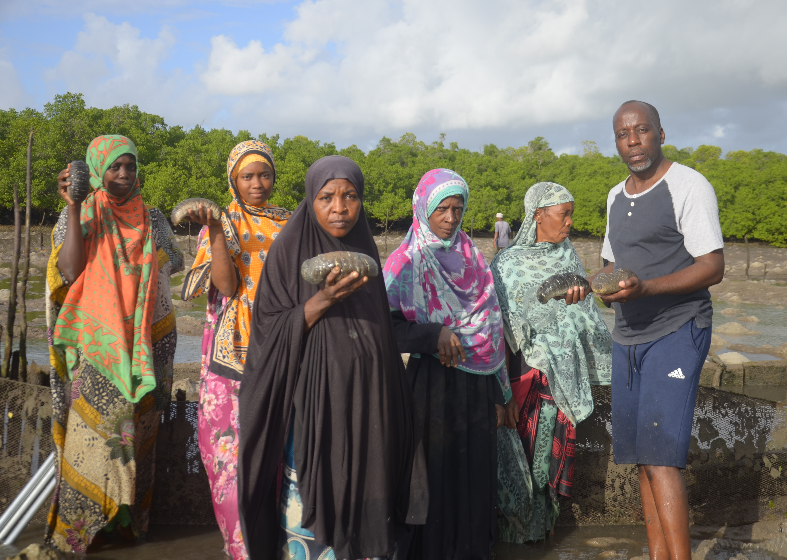
Daud Salum with Shehia Fishers Committee members, Pemba Island

Invest in the platform.

A network of community ocean enterprises that shares one hatchery, one processing chain and one route to market.

Invest →